


How to Align Customer Feedback Management with Business Goals for Maximum Impact

How to Align Customer Feedback Management with Business Goals for Maximum Impact
Every decision a company makes should begin with a simple question: What do our customers truly need? Businesses receive customer feedback in emails, chats, surveys, and social platforms, but the challenge is not in how the data is collected, but how the data is used. When the customer feedback links with your business objectives, it will be a strong engine that will lead to growth, loyalty, and innovations.
That is where platforms such as Teptro make it easier. The customer feedback management software assists organisations to gather, structure and take action on their customer feedback easily, transforming unstructured feedback into data that is considered to take action and produce tangible outcomes. We will discuss the way in which alignment of feedback data with business objectives can have maximum impact on your organisation.
The Real Value of Customer Feedback Data
The feedback that you get as a customer is the complete picture of your business as seen by your customers. It is not just the answers of the survey, it is all the product suggestions, feature requests and complaints. A lot of these signals hold useful information on what your audience appreciates and what they want.
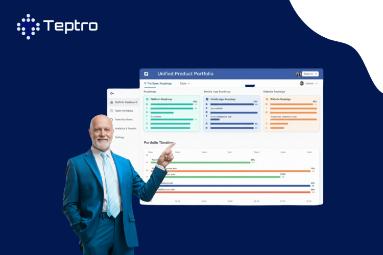
With user feedback software such as Teptro, you can receive feedback on various sources, such as your website, app, or even built-in tools and then group it in a Unified Feedback Inbox. It allows you to see the patterns, discover opportunities, and make data-driven decisions to bring your business closer to its purpose.
Feedback becomes valuable only when it is changed into strategic activities, those activities that maximise customer experiences and build long-term relationships.
You May Also Like: How Product Roadmap Software Turn Business Strategies into Real Results
When Feedback and Business Goals Don’t Talk
Most organisations receive huge volumes of feedback that they do not correlate to strategic goals. The data is usually siloed: marketing statistics show reactions to the campaign, a support department receives the feedback about a problem, and product teams receive a list of features demanded; however, none of this information is linked.
Suppose that your product team does not know that several customers are demanding certain integration, and your sales team is losing out on opportunities due to the lack of such an option. The result of this disconnection is lost opportunities and prioritisation.
Teptro addresses this by assisting in putting all feedback in a single location. Businesses will be able to classify the insights based on the product, team, or project through custom feedback boards. It ensures that you use all feedback efficiently to make your product roadmap and general business direction.
A Step-by-Step Framework to Align Feedback Data with Business Goals
Step 1: Define Clear Business Objectives
Begin with the establishment of quantifiable business objectives. There should be a feedback measure for each goal. To illustrate that your target is to enhance customer experience, you can associate it with trends in the support-related feedback.
Teptro assists by enabling businesses to collect the best data they require to follow these goals by creating custom fields and post templates.
Step 2: Collect Multi-Source Feedback
There are multiple ways that customers can get in touch with your business. Receive feedback about their visits to your website, app, and other content that is immediately incorporated into Teptro, Smart Automation, and Integrations. Additionally, it eliminates the need for manual data collection and guarantees that all of your comments and ideas will show up in real time on your dashboard.
Step 3: Categorise and Analyse Data
After receiving feedback, it is essential to analyse and divide it into meaningful segments. The feedback analytics dashboards of Teptro render this hassle-free. The voting trends, sentiment, and engagement levels can be followed by businesses to identify patterns, unveiling what customers stand to be of prime importance.
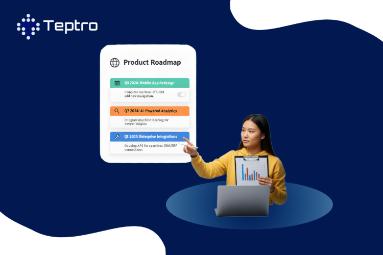
This analysis is related to your business KPIs directly - when customers keep on requesting some features, you are in a position to correlate the same to your product roadmap software and plan releases.
Step 4: Map Insights to Strategic Actions
Alignment is formed in the process of putting the insights into practice. For example, feedback shows that the customers have issues with onboarding, you can redesign the user flow, or you can create help documents.
Teptro streamlines this process using comments and moderation features, enabling teams to brainstorm, combine duplicated ideas, and take action on the most important things.
It is also possible to label and follow internal notes- hence any improvement is a direct result of confirmed customer information.
Step 5: Close the Feedback Loop
The alignment would not be complete until your customers see the result of their feedback. Using the product changelog software by Teptro, you can communicate new releases, fixes and updates transparently. When users can see that their suggestions are converted to actual improvements, this builds confidence and interest.
A loop enables feedback to become a two-way dialogue, as opposed to a one-way submission of the feedback.
The Role of Technology in Feedback Alignment
Technology is vital in ensuring feedback alignment is scalable and efficient. The latest customer feedback management solutions, such as Teptro, are automated to gather information, arrange insights, and present this data in graphical dashboards to gain immediate insights.
You can use real-time feedback analytics to pinpoint satisfaction drivers and focus on actions that contribute to business objectives. Tagging with AI, trend visualisation, and automation can make sure that feedback is never lost.
By combining feedback and other solutions such as CRM, helpdesks and analytics systems, you can match customer sentiment to performance metrics. When Teptro uses a data-driven development method, the decisions made by the business are informed by customers and goal-focused.
Measuring the Impact of Aligned Feedback
After getting feedback data that is aligned with business goals, measurement is crucial. Customer satisfaction levels, feature adoption rates, churn rates, and retention rates can indicate whether your strategies are effective or not.
Teptro provides it using visual feedback reports and downloadable analytics. You can keep track of trends over time, see what programmes were used to improve the situation, and evaluate the ROI of all changes driven by feedback.
What to consider: running quarterly feedback performance reviews with leadership teams reviewing the role played by customer insights in achieving business targets. This organised method puts feedback as an objective measure of growth instead of a passive investment.
Why Choose Teptro for Feedback Alignment
- Teptro streamlines all the steps of feedback alignment, including collection and analysis to action. Businesses benefit from:
- Feedback gathering through multi-channel feedback that gathers information at the points of contact with the customer.
- Live analytics dashboards that transform raw data into insights.
- Automation and integrations that link the feedback to your internal tools.
- The product development is based on a factual basis that ensures your roadmap is in line with customer priorities.
- Transparency and engagement software that seals the feedback loop and enhances relationships.
- With Teptro, businesses are not able to just listen to their customers; they are developed with them.
Final Thought
The most valuable resources a company may have are customer responses. But only when it's strategic. When companies put the feedback and direction on the same page, all insights will convert into growth opportunities.
Using the customer feedback management tool of Teptro, you can centralise the user insights, relate them to the main goals, and define their actual business contribution. From the time of collection to automation/analysis to execution, Teptro ensures that each voice is adding to better decisions and outcomes.
Ultimately, the secret to success is change-change of feedback into progress and of data into direction. With Teptro, such a change is easily accomplished.
Want to collect feedback from different channels?

If yes, Then Explore Antrika Features -





Discover, Learn & Build Better with Teptro
From feedback to product planning—Teptro helps you simplify your journey.